
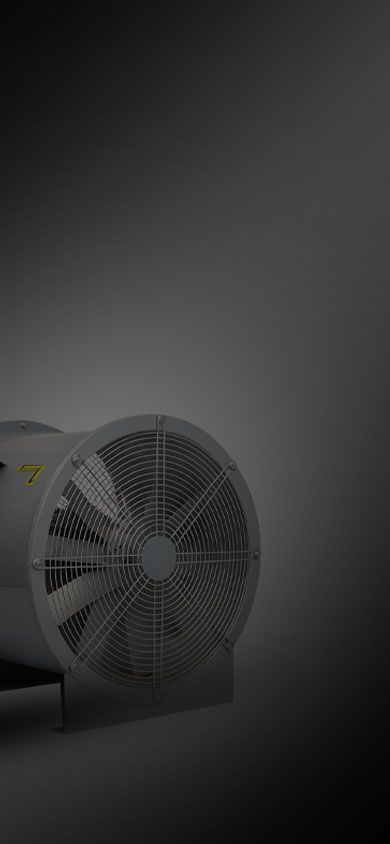
Industrial ventilators and fans
1405-05-03In the industries of developed countries, approximately 15% of the total electricity consumed by electric motors is used by fans.
Axial fan
1405-05-03Among the various types of industrial fans, axial fans are one category, which are further subdivided into several distinct types.
Parking Ventilation
1405-05-03Designing a smoke exhaust system to reduce the concentration of hazardous airborne particles in large areas such as parking garages, tunnels, and industrial halls that contain sources of air pollution is very important and of great significance.
Eliminating Ductwork in Parking Garages
1405-05-03In the ventilation of pollutants in large spaces such as automobile parking garages, jet fans are preferred over traditional ducted systems for smoke exhaust ventilation.
Types of Fan Jets
1405-05-03To make the best use of space and energy while ensuring adequate ventilation in environments such as parking garages and tunnels, the use of jet fans is highly recommended. Jet fans are available in various types, depending on their performance, airflow capacity, and dimensions, which we will briefly introduce below.
Computational Fluid Dynamics (CFD)
1405-05-03For ventilation and air extraction in places such as parking garages and tunnels, jet fans are used. In order to select the appropriate jet fans, it is first necessary to perform fluid dynamics calculations and simulations. Initially, the required airflow rate for ventilation must be determined, and then, based on the geometry of the space, a fluid simulation is conducted, leading to the selection of the jet fans. To select the right jet fans, the following factors must be taken into consideration:
Industrial Fan
1405-05-03Industrial ventilation systems typically include hoods, ducts for conveying contaminated air, filters, and fans for exhaust and fresh air supply. In essence, an industrial fan is a device capable of moving air or air contaminated with gases and smoke. There are two broad categories of air handling systems: local exhaust ventilation and general (dilution) ventilation.
Roof-Mounted Centrifugal Fan
1405-05-03Roof-mounted centrifugal fans are the most common type of centrifugal fans. They are also known by various names such as mushroom-type industrial fans, radial roof fans, rooftop centrifugal fans, and power-roof centrifugal fans.
Centrifugal Fan Types
1405-05-03In a centrifugal fan, air enters the impeller along the axial direction (perpendicular to the impeller surface) and is discharged tangentially from the impeller.
Smoke exhaust fan for hoods
1405-05-03According to Topic 14 of the National Building Regulations, the air required for hood smoke exhaust fans must be supplied during their operation. Depending on the type of cooking appliance (usage type), the exhaust air volume for three-sided and four-sided hoods must be at least equal to the values specified in the table below.
Types of Rooftop Fans
1405-05-03Both types of rooftop fans are equipped with a hood or cover on top of the unit. Rooftop centrifugal fans are more widely used compared to rooftop axial fans. In general, centrifugal models produce less noise and offer higher efficiency than axial types. Rooftop centrifugal fans are applicable across all industries, while axial models are more commonly used in residential and small office buildings, as well as in industrial factories.
Shaft Cross-Section and Damper Area Calculation in F300 Parking Smoke Exhaust System Design
1405-05-03For the design of an F300 parking smoke exhaust system, it is necessary to calculate the cross‑sectional area of the shafts based on the required smoke exhaust flow rate and the amount of makeup air. In calculating the shaft cross‑section, architectural constraints must be carefully taken into account. (At this stage, it is essential to coordinate with the architectural engineering team to reach an appropriate solution in terms of dimensions and proper shaft positioning.)
Power Plant Silencer Fans for Suction and Discharge – Saba 29 MW Power Plant Project
1405-05-05Power plants generate high levels of noise pollution, so when selecting equipment for these facilities, every effort should be made to minimize the noise output of each component as much as possible.
Advantages of Cabinet Fans
1405-05-05In centrifugal fan systems, impellers are generally divided into two types based on their blade design: forward-curved and backward-curved. These two categories are further classified into two configurations based on their overall housing design: cabinet-mounted fans (enclosed fans) and non-cabinet (open) fans. Each type comes with its own set of advantages and disadvantages.
Overview of Power Plant Silencer Fans
1405-05-05All types of power plants—including steam, gas, combined cycle, and others—must be equipped with proper ventilation and cooling systems for their energy production equipment to minimize the risk of process interruption. The HVAC and cooling system in a power plant is responsible for enhancing energy generation conditions by providing thermal protection for equipment, supplying fresh air for personnel, and maintaining suitable environmental conditions throughout the facility's operations.
How to Calculate Volumetric Flow Rate and Pressure Drop in Fans
1405-05-05First, calculate the total volume of the space to be ventilated by multiplying its length, width, and height (Length × Width × Height). Then, by applying the standard air exchange rate coefficient for that specific type of space, the required airflow (Q in m³/h) is determined. Next, the static pressure drop is determined using the appropriate performance curve, based on the duct dimensions and total length.
F300 Car Park Smoke Exhaust System Design by Maksh va Dahsh Company
1405-05-05Maksh va Dahsh Tahvieh Tasisat Company operates in the field of parking ventilation and smoke management systems, offering a comprehensive range of services including F300 car park smoke exhaust system design, dynamic simulation (CFD) under various scenarios such as CO concentration analysis and fire conditions, as well as supply of all related equipment including smoke fans, supply fans, axial and compact centrifugal jet fans, motorized dampers, CO sensors, power distribution panels, and PLC programming. The company also provides supervision and turnkey (EPC) execution, effectively delivering all parking ventilation and fire smoke exhaust services as a complete package.
F300 Car Park Smoke Exhaust System Design
1405-05-05The smoke exhaust system design for a parking facility must be delivered as a complete package, incorporating various fire and smoke exhaust scenarios. This package starts with pollutant detectors, fire location sensors, and alarm systems, and extends to include speed control systems, dampers, electrical control panels, and fans—all fully integrated.
Indoor Design Conditions in Buildings
1405-05-05Indoor design conditions in residential buildings depend on temperature, humidity, and fresh air supply to achieve human thermal comfort.
Allowable Velocity in Ventilation Ducts
1405-05-05Air distribution is one of the most common methods for providing thermal comfort in an indoor environment. It is carried out for various purposes, including cooling or heating the air, humidifying or dehumidifying it, removing airborne contaminants, and more. Ductwork is considered one of the most critical components of any air distribution system. A duct is essentially an enclosed passageway designed to convey conditioned air—whether cooled, heated, humidified, dehumidified, or filtered—to the desired space.
Zoning in F300 Car Park Smoke Exhaust System Design
1405-07-18One of the key factors influencing the design of an F300 car park smoke exhaust system is the zoning of the parking space. A smoke zone is a defined area within a parking facility where appropriate barriers are used to prevent the potential spread of smoke to adjacent areas.
How to Use a Ductulator for Sizing Ventilation Ducts
1405-05-05A ductulator is a manual circular slide rule used to size ductwork in HVAC systems. By inputting the required airflow volume (based on the fan capacity) along with at least one of three key parameters—namely, the pressure drop per 100 feet of duct, the diameter of a round duct, or the dimensions of a rectangular duct—the tool can determine the remaining two values.
Ventilation Airflow in F300 Car Park Smoke Exhaust Design
1405-05-05One of the most critical parameters in F300 car park smoke exhaust system design is calculating the required airflow rate for smoke extraction and the corresponding make‑up air volume. These calculations form the basis for determining fan capacities, duct sizes, and damper specifications.
Car Park Jet Fan
1405-07-22Make-up air (fresh air) is the amount of outdoor air that is mechanically introduced into the parking area to replace the air being exhausted. The fans used to supply this fresh, uncontaminated air into the space are referred to as make-up air fans (supply fans).
Parking Air Exhaust, Design, and CFD Simulation
1405-05-05In the design of parking smoke exhaust systems, after completing all design steps—including determining the layout of detection systems, locating control panels, and finalizing the placement and angle of jet fans, dampers, main exhaust fans, and supply fans—a verification method must be employed to ensure the design's accuracy. This step is essential for checking all design parameters and confirming that the system will perform as intended under both normal and emergency conditions.
Startup Delay for F300 Jet Fans
1405-05-05As previously discussed in the context of F300 parking smoke exhaust system design objectives, one of the key purposes of using F300 jet fans is to provide a safe evacuation route for occupants in the event of a fire. However, the automatic activation of jet fans can sometimes disrupt smoke stratification layers, potentially hindering occupant evacuation. For this reason, an appropriate delay must be incorporated to allow sufficient time for safe egress.
Boilers
1405-05-05A boiler is a device used to produce heated fluid in hydronic and steam central heating systems. Boilers can be classified into three main categories based on their function: hot water boilers, high‑temperature water boilers, and steam boilers. In terms of construction material, they are divided into two groups: cast iron and steel.
Cooling Tower
1405-05-05A cooling tower is a device that removes excess heat from HVAC equipment and dissipates it into the surrounding environment.
HVAC Ductwork
1405-05-05In most HVAC systems, ductwork is used to distribute heating and cooling, ventilate indoor spaces, and supply fresh air to the building. Depending on the design and application, ducts can be made from a variety of materials. Some of the most commonly used types include galvanized steel ducts, aluminum ducts, pre‑insulated ducts, flexible ducts, fabric ducts, plastic ducts, and others, each of which will be briefly discussed below.
Centrifugal Exhaust Fan
1405-05-05In a centrifugal exhaust fan, air enters the impeller along the axial direction (perpendicular to the impeller face) and is discharged tangentially (radially outward) from the impeller. A centrifugal exhaust fan can be of any of the three main blade types: backward-curved, forward-curved, or radial.
F300 Car Park Exhaust Fan
1405-05-05According to fire department regulations, buildings with three or more basement levels, or where any basement level exceeds 500 square meters in area, must be equipped with a parking ventilation system. This means that polluted air must be mechanically exhausted from the system, and fresh air must be mechanically supplied into it.
Chiller
1405-05-06Chillers are responsible for cooling the water required by various cooling systems. The chilled water produced by chillers is used in fan coil units and the cooling coils of air handling units (AHUs). After being cooled in the chiller, the water is circulated through connecting pipes to HVAC devices such as AHUs, where it absorbs heat from the conditioned space, then returns to the chiller to be cooled again—a cycle that repeats continuously. Chillers are broadly classified into two main categories: absorption chillers and vapor compression chillers.
Car Park Ventilation Systems
1405-07-18In enclosed car parks, natural air discharge is not possible, and fresh air supply, extraction of polluted air, and smoke clearance during a fire must be handled mechanically. Generally, car park environments are ventilated using two main methods: 1- Ducted ventilation 2- Ventilation using jet fans. In ventilating pollutants in large spaces such as car parks, ventilation using jet fans is preferred over traditional ducted systems. Faster and easier installation, smaller footprint, lower energy consumption, smart control of fans, jet fans, and motorized dampers, superior performance in smoke control during a fire, lower noise generation and consequently less acoustic pollution, and the elimination of unventilated dead corners are among the advantages of using jet fans instead of ducted systems.
Roof-Mounted Centrifugal Fan
1405-07-18Introduction to roof-mounted centrifugal fans – covering features, airflow capacity, suitable pressure for long ducts, and industrial applications by Mackesh & Dahesh.
The Definitive Guide to Air Handling Units (AHUs)
1405-07-18Every modern office tower, hospital, and manufacturing facility relies on a quiet, invisible workhorse to keep people healthy and productive. While most people are familiar with individual room air conditioners or simple exhaust vents, the true backbone of large-scale climate control is the Air Handling Unit, widely known as an AHU.
Comparing Natural Ventilation vs. Mechanical Ventilation
1405-07-18Natural forces—such as wind and thermal buoyancy (the stack effect driven by indoor–outdoor air density differentials)—direct outdoor air into a building and push indoor air out through windows, doors, and skylights.