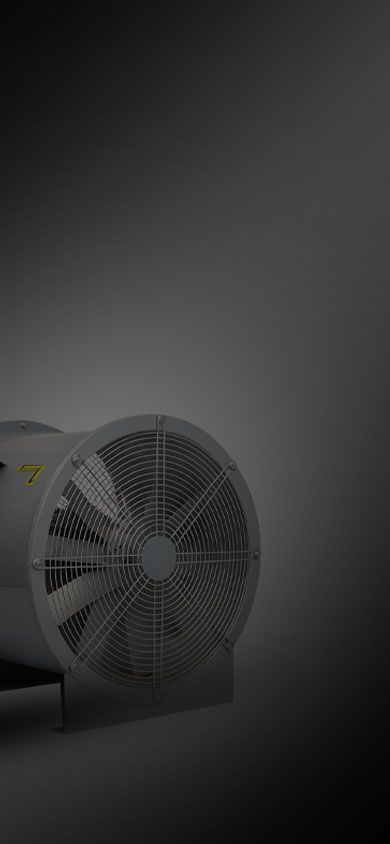
Axial fan
Axial Fans
Axial fans, as their name suggests, move airflow along their axis. After passing through the blades, the air is pressurized due to the lift force generated by aerodynamics and changes direction. It then redirects again through the outlet path and ultimately exits the fan in the same direction as the inlet velocity.
Propeller Fans
Propeller fans are the simplest type of axial fans, used to generate high airflow at low pressure and are commonly utilized in ventilation systems and industrial exhaust applications. Since the pressure generated by these fans is low, they do not require large ducts or channels. Due to their simple blade structure, typically consisting of two or more lightweight blades, the cost of this industrial fan is low, and they are also capable of producing reverse flow, which is highly important in ventilation applications. These fans can be connected to the motor either directly or via belts. Their disadvantages include relatively high noise levels and low energy efficiency.
Tubeaxial Fans
Tubeaxial fans are a type of axial fan in which the blades are enclosed within a cylindrical housing. In these fans, by improving the inlet flow characteristics, higher pressure and efficiency are achieved. They are used for medium-pressure and high-flow applications.
Vaneaxial Fans
Vaneaxial fans are a more complex type of axial fan, in which the blades are positioned inside a cylindrical tube in such a way that they modify the flow pattern and convert the kinetic energy of the incoming flow into pressure. These fans offer the highest efficiency among axial fans and are used for medium to high-pressure applications. If their blades are of the airfoil type, their efficiency can exceed 85%.
related projects