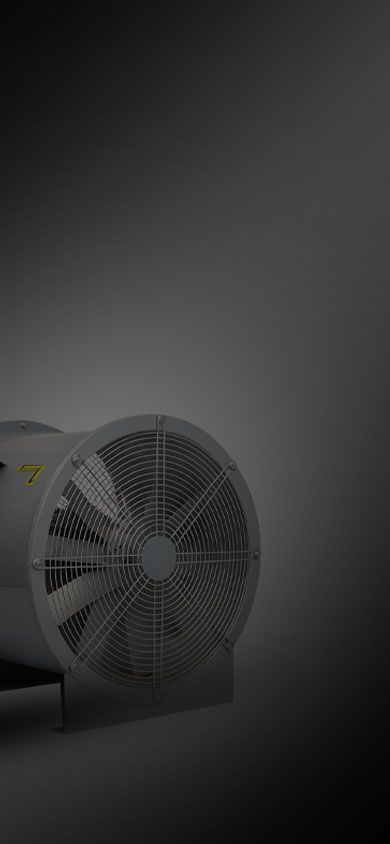
Comparing Natural Ventilation vs. Mechanical Ventilation
The feasibility and effectiveness of relying on natural airflow depend heavily on the local climate and architectural layout. Maximum cross-ventilation occurs under specific conditions—for example, when windows on opposite sides of a space are left open to create an unobstructed airflow path.
However, natural ventilation systems present significant limitations:
- Windows are typically kept closed at night or during cold weather.
- Their performance is directly dependent on unpredictable wind patterns, resulting in inconsistent efficiency.
- Natural airflow cannot overcome static pressure drops in ductwork or guarantee target supply and exhaust airflow rates; consequently, its practical use is largely confined to roof vents on open-span industrial sheds and warehouses
Mechanical and industrial fans can be installed directly into walls or connected through duct systems. Crucially, they can be fully integrated with HVAC filtration and conditioning systems, giving operators complete control over intake and exhaust airflow rates.
The choice of mechanical ventilation strategy also depends on the local climate:
- Hot and Humid Climates: Air infiltration must be minimized to prevent moisture intrusion and condensation. In these conditions, positive-pressure ventilation is typically recommended, using supply fans (often equipped with forward-curved impellers).
- Cold Climates: To reduce condensation inside the building envelope, outward air exfiltration must be controlled. In these scenarios, negative-pressure ventilation using exhaust fans (typically featuring backward-curved impellers) is preferred
- Source-Pollutant Areas: Localized spaces where odors or moisture are generated (such as restrooms, bathrooms, or commercial kitchens) universally require negative-pressure exhaust fans.
In summary, forward-curved centrifugal fans or in-line axial fans are generally utilized for positive-pressure air supply, while backward-curved centrifugal fans are standard for negative-pressure exhaust.=
To select the ideal unit for your project specifications, you can use the proprietary Mackesh & Dahesh selection software. The software allows you to precisely calculate and determine airflow capacity (CFM/CMH), static pressure drops, duct sizing, outlet velocities, sound levels (dB), operational efficiency, and actual motor power requirements.
For more information, please visit: www.mackesh-dahesh.ir
related projects